
Putting Feet on Their Prayers: George and Melanie’s Story
Some people come to the Real Life Center looking for a place to help. George and Melanie came knowing exactly what it feels like to need one.
A storm, and a decision
On October 10, 2018, Hurricane Michael came ashore at Mexico Beach, Florida, as a Category 5. George and Melanie were living there most of the year by then, keeping their longtime home in Colquitt, Georgia, for the rest. The storm flattened Mexico Beach. Three hours later, it reached Colquitt and hit as a Category 3.
One storm. Both homes. The same day.
“A five and a three in one day,” George said.
Their daughter, who lives in Peachtree City, told them to come north and stay with her. But George was still serving on the Colquitt City Council, and his city was in pieces. So, they stayed one more night, loaded their truck with food, and drove home to a town with no power and no water. Trees had to be cleared before they could even reach their own front door.
They went to the fire station instead. The fire department had a generator, and for the next 15 to 20 days, George and Melanie cooked two meals a day for the 700 volunteers who had come to help clean up Colquitt.
Ten days into that, Melanie still had not had a shower. The fire chief, a friend of theirs, had a generator at his house, and she finally went over for a hot one. She came back, got into bed, and cried.
That was the night George said out loud what neither of them had expected to hear. “We’re going to sell it all and leave.”
Two days later, their daughter started looking for a house for them. On January 28, 2019, they moved, close enough to see three of their grandchildren regularly.
One storm. Both homes. The same day.
“A five and a three in one day,” George said.
Their daughter, who lives in Peachtree City, told them to come north and stay with her. But George was still serving on the Colquitt City Council, and his city was in pieces. So, they stayed one more night, loaded their truck with food, and drove home to a town with no power and no water. Trees had to be cleared before they could even reach their own front door.
They went to the fire station instead. The fire department had a generator, and for the next 15 to 20 days, George and Melanie cooked two meals a day for the 700 volunteers who had come to help clean up Colquitt.
Ten days into that, Melanie still had not had a shower. The fire chief, a friend of theirs, had a generator at his house, and she finally went over for a hot one. She came back, got into bed, and cried.
That was the night George said out loud what neither of them had expected to hear. “We’re going to sell it all and leave.”
Two days later, their daughter started looking for a house for them. On January 28, 2019, they moved, close enough to see three of their grandchildren regularly.
“We really do not want you to just occupy a seat”
They joined Dogwood Church on August 9, 2019.
Every Sunday, the same greeter met them at the door with the same warmth. After about the third week, Melanie had had enough of small talk. “We need to be friends,” she told her. They hugged. Cecelia has been their friend ever since, and she was the first to mention the Real Life Center.
Not long after, sitting in a Sunday service, they heard Pastor Keith say something George has never forgotten; we are glad you are here, but we do not want you just to occupy a seat. Get plugged in.
“I thought, he’s talking to us,” George said.
They had been deeply plugged in at their church back home, so they knew the difference. They also knew something else. Seven hundred people had shown up in Colquitt to feed them, clear their streets, and put their town back together. “Number one,” George told Melanie on the drive home, “we need to give back for those people that came and gave to us.”
So, when Cecelia invited them to come see the Real Life Center, they went. That was three years ago.
There was one more small confirmation along the way. When they first introduced themselves to Pastor Keith, Melanie gave her usual line about coming from a small town in southwest Georgia that he would never have heard of. He told her he goes to Colquitt every year for a family reunion. He even knew the Hardee’s, the only fast-food restaurant in town.
Every Sunday, the same greeter met them at the door with the same warmth. After about the third week, Melanie had had enough of small talk. “We need to be friends,” she told her. They hugged. Cecelia has been their friend ever since, and she was the first to mention the Real Life Center.
Not long after, sitting in a Sunday service, they heard Pastor Keith say something George has never forgotten; we are glad you are here, but we do not want you just to occupy a seat. Get plugged in.
“I thought, he’s talking to us,” George said.
They had been deeply plugged in at their church back home, so they knew the difference. They also knew something else. Seven hundred people had shown up in Colquitt to feed them, clear their streets, and put their town back together. “Number one,” George told Melanie on the drive home, “we need to give back for those people that came and gave to us.”
So, when Cecelia invited them to come see the Real Life Center, they went. That was three years ago.
There was one more small confirmation along the way. When they first introduced themselves to Pastor Keith, Melanie gave her usual line about coming from a small town in southwest Georgia that he would never have heard of. He told her he goes to Colquitt every year for a family reunion. He even knew the Hardee’s, the only fast-food restaurant in town.
What a Wednesday looks like
Melanie serves as a shopping assistant. George is a loader. That is where they started, and it is still their Wednesday.
It is nowhere close to all of it, though. They serve at the Mobile Food Pantry nearly every month unless they are out of town, and they have joined the new Home Delivery Program. They have packed bags for Backpack Buddies, picked blueberries in the orchard, and sorted toys at Christmas. This is their second summer helping with Real Life Center Summer Day Camp. George also serves on the Real Life Center Board.
That last one required a little negotiating. Over the years, Melanie has given George exactly two rules: do not join the HOA or any other board, and do not run for city council. So, when he came home from a conversation with Pastor Keith and explained that this board was very different, Melanie, who had heard a version of this before, reminded him that the city council was also only going to be one or two nights a week.
George serves on the Real Life Center Board today.
It is nowhere close to all of it, though. They serve at the Mobile Food Pantry nearly every month unless they are out of town, and they have joined the new Home Delivery Program. They have packed bags for Backpack Buddies, picked blueberries in the orchard, and sorted toys at Christmas. This is their second summer helping with Real Life Center Summer Day Camp. George also serves on the Real Life Center Board.
That last one required a little negotiating. Over the years, Melanie has given George exactly two rules: do not join the HOA or any other board, and do not run for city council. So, when he came home from a conversation with Pastor Keith and explained that this board was very different, Melanie, who had heard a version of this before, reminded him that the city council was also only going to be one or two nights a week.
George serves on the Real Life Center Board today.
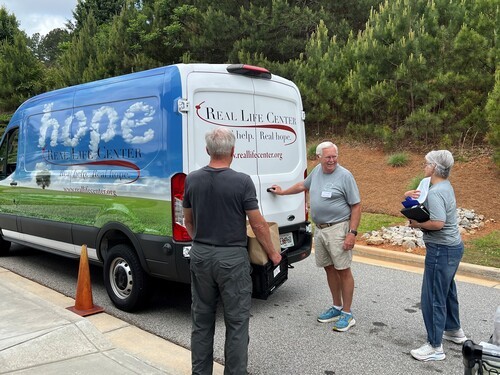
The back of the warehouse
Ask George what the Real Life Center means to him, and he does not start with the work.
“Melanie and I are not really small group people,” he said. “But the Real Life Center has become our small group.”
The guys in the back share what is going on with their families. They ask each other real questions. They pray together, and they have a devotion. George found a close friend in Joe, who was doing the same kind of serving George had done back home. The work itself has a goal, and George has said it out loud to himself: make sure the client feels like they mean something.
As a car loader, “the last thing they hear is us guys putting their groceries in their cars,” he said. “Give them a word of encouragement. Because it’s just by the grace of God that we’re not in that position.”
Both of them know that the people who come through the door are not one kind of person. Some of them were doing fine until a job disappeared. “It could happen to anybody.”
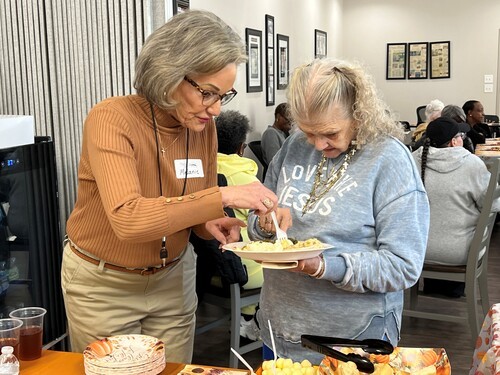
Up front, Melanie greets every single one of them, and anyone sitting in the building can hear her. There is joy in her voice, and it lands on people who are having the worst week of their lives.
“It’s not fake,” she said. “I really do feel the way I sound.”
“Melanie and I are not really small group people,” he said. “But the Real Life Center has become our small group.”
The guys in the back share what is going on with their families. They ask each other real questions. They pray together, and they have a devotion. George found a close friend in Joe, who was doing the same kind of serving George had done back home. The work itself has a goal, and George has said it out loud to himself: make sure the client feels like they mean something.
As a car loader, “the last thing they hear is us guys putting their groceries in their cars,” he said. “Give them a word of encouragement. Because it’s just by the grace of God that we’re not in that position.”
Both of them know that the people who come through the door are not one kind of person. Some of them were doing fine until a job disappeared. “It could happen to anybody.”
Up front, Melanie greets every single one of them, and anyone sitting in the building can hear her. There is joy in her voice, and it lands on people who are having the worst week of their lives.
“It’s not fake,” she said. “I really do feel the way I sound.”
The Barbie in the pearl wedding gown
She learned generosity a long time ago, and it cost her something.
Melanie was around ten or eleven when Barbie dolls first came out. She had three: a Barbie, a Midge, and a Ken. Not twenty-five, like her grandchildren have today—just the three.
Her mother was a gifted seamstress, and one Christmas Eve she stayed up until two in the morning sewing tiny pearls onto a wedding gown for Melanie’s Barbie, along with a full wardrobe for Midge and Ken.
A couple of years later, Melanie walked past a house in her town where the children had nothing. There was no grass in the yard. They were playing with sticks. She could see them, and she could see her own life clearly at the same time: a swimming pool, a tennis court, a billiard hall, a camper parked out back.
She went home, gathered up every bit of it, the dolls and all the clothes her mother had stayed up all night to make, walked back over, and handed it to a little girl.
She had not asked for permission first. When she told her mother, her mother was not angry. She was glad to see that her daughter had a caring heart.
A week later, Melanie walked by again and found the Barbie in the dirt across the yard. The body was on its side. The head was off.
She has never forgotten what she decided while standing there.
“When I give a gift to somebody, there are not going to ever be strings attached to it,” she said. “Because it’s theirs to do whatever with. It’s not mine any longer.”
Underneath it is the sentence that has shaped her life ever since: “If you have more, you should give more.”
Melanie was around ten or eleven when Barbie dolls first came out. She had three: a Barbie, a Midge, and a Ken. Not twenty-five, like her grandchildren have today—just the three.
Her mother was a gifted seamstress, and one Christmas Eve she stayed up until two in the morning sewing tiny pearls onto a wedding gown for Melanie’s Barbie, along with a full wardrobe for Midge and Ken.
A couple of years later, Melanie walked past a house in her town where the children had nothing. There was no grass in the yard. They were playing with sticks. She could see them, and she could see her own life clearly at the same time: a swimming pool, a tennis court, a billiard hall, a camper parked out back.
She went home, gathered up every bit of it, the dolls and all the clothes her mother had stayed up all night to make, walked back over, and handed it to a little girl.
She had not asked for permission first. When she told her mother, her mother was not angry. She was glad to see that her daughter had a caring heart.
A week later, Melanie walked by again and found the Barbie in the dirt across the yard. The body was on its side. The head was off.
She has never forgotten what she decided while standing there.
“When I give a gift to somebody, there are not going to ever be strings attached to it,” she said. “Because it’s theirs to do whatever with. It’s not mine any longer.”
Underneath it is the sentence that has shaped her life ever since: “If you have more, you should give more.”
Forty-seven years, one goal
George and Melanie celebrated 47 years of marriage this year, and they say the same thing about the hurricane that they say about most things.
“Stuff can be replaced. But if you have each other, and you have the same goal of wanting to do for others, that’s the important thing in life.”
Every Wednesday, after serving at the Real Life Center, they get in their vehicle to drive home and immediately start telling each other what somebody said that day. They come to serve, and they leave with more than they brought.
Years ago, at a Sunday morning service at a campground, George heard a speaker say something that stuck with him: you can pray all you want, but if you do not put feet on those prayers, they are not going anywhere.
George and Melanie have put feet on theirs.
“We don’t think we’re special at all,” Melanie said. “We just think we’re part of the team that loves to love others.”
“Stuff can be replaced. But if you have each other, and you have the same goal of wanting to do for others, that’s the important thing in life.”
Every Wednesday, after serving at the Real Life Center, they get in their vehicle to drive home and immediately start telling each other what somebody said that day. They come to serve, and they leave with more than they brought.
Years ago, at a Sunday morning service at a campground, George heard a speaker say something that stuck with him: you can pray all you want, but if you do not put feet on those prayers, they are not going anywhere.
George and Melanie have put feet on theirs.
“We don’t think we’re special at all,” Melanie said. “We just think we’re part of the team that loves to love others.”
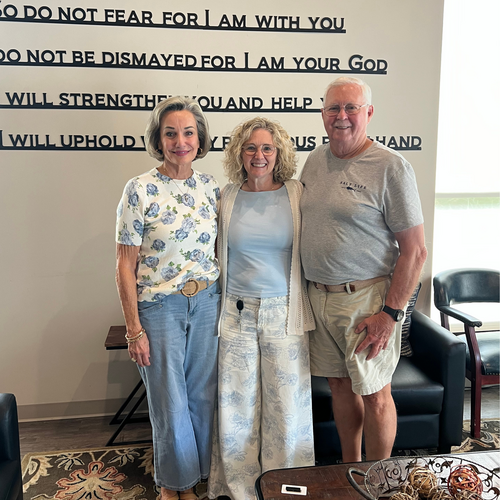
Come see a Wednesday for yourself
You do not need a story like George and Melanie’s to serve here. You just need to show up. Every week, families across Coweta and Fayette counties walk through our doors, and every week there is room for one more person to greet them, shop with them, or load their car with a word of encouragement.
To learn more about volunteering at the Real Life Center, click the "LEARN MORE" button below.
To learn more about volunteering at the Real Life Center, click the "LEARN MORE" button below.
Posted in Real Life Real Stories
Posted in Real Life Center, Volunteer Stories, Coweta County, Fayette County, Community Service, Faith in Action
Posted in Real Life Center, Volunteer Stories, Coweta County, Fayette County, Community Service, Faith in Action
Recent
From Survival Mode to Rest: Jefferson Russell's Story of Hope
September 3rd, 2026
Right on Time: How One Prayer, One Phone Call, and One Orchard Changed Two Families’ Lives
August 27th, 2026
Christmas in July: Edward Jones Advisors Keep Our Shelves Full When Summer Runs Thin
August 13th, 2026
One Door, Two Programs: How Real Life Center Walks Families Toward Stable Living
August 12th, 2026
Putting Feet on Their Prayers: George and Melanie’s Story
August 6th, 2026
Archive
2026
January
February
April
June
July
How One Woman's Memory Turned Into Lasting Support for Coweta and Fayette County StudentsCalled, Not Lost: How Real Life Center Helped One Family Stay the CourseA Summer of Generosity: How Keller Williams and Kares 4 Kids Are Investing in Local KidsA New Way to Reach Our Neighbors: Real Life Center Home Delivery Program
August
Putting Feet on Their Prayers: George and Melanie’s StoryOne Door, Two Programs: How Real Life Center Walks Families Toward Stable LivingChristmas in July: Edward Jones Advisors Keep Our Shelves Full When Summer Runs ThinRight on Time: How One Prayer, One Phone Call, and One Orchard Changed Two Families’ Lives
No Comments